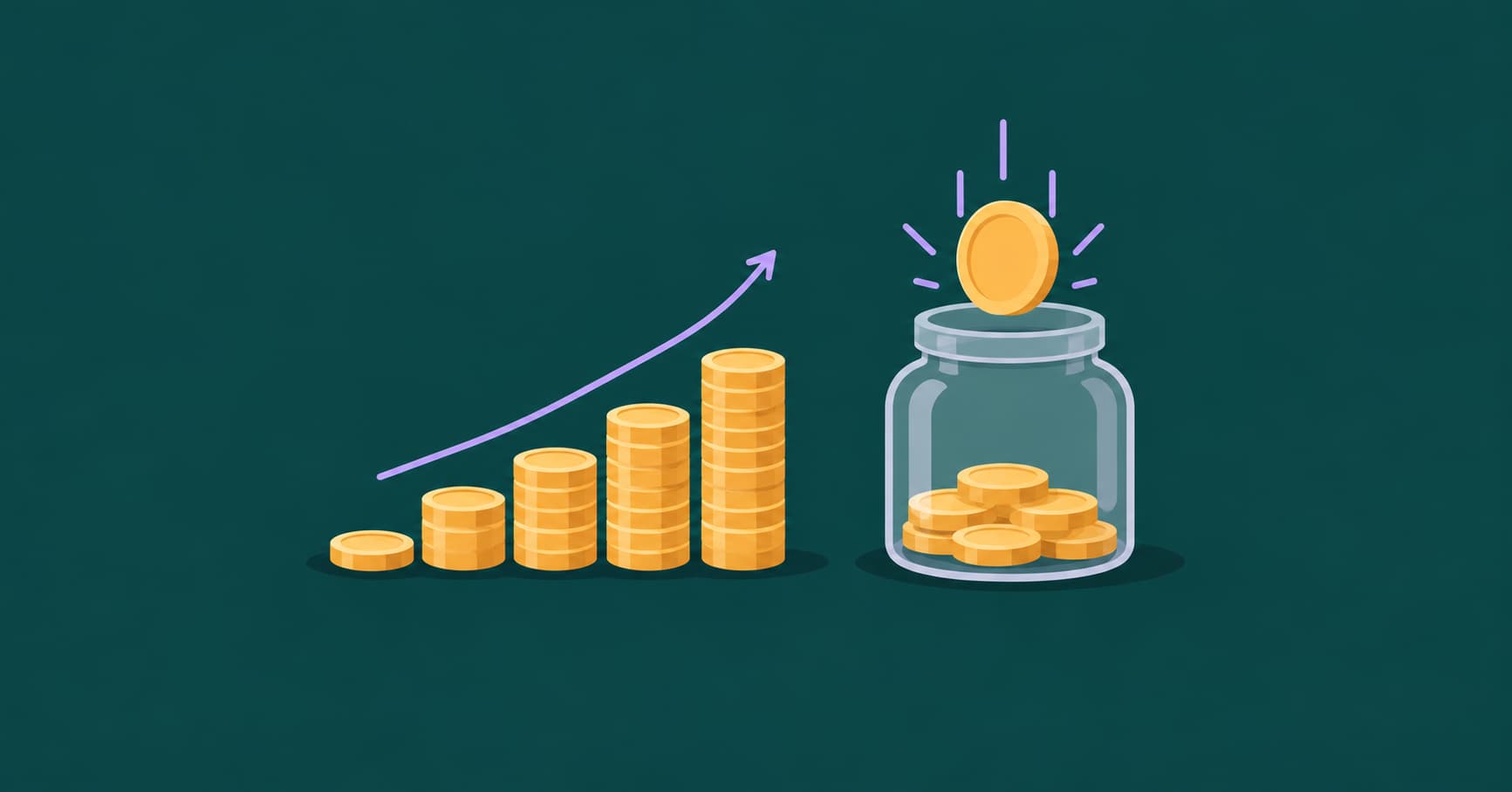
In the early years of building wealth, how much you save matters far more than the return you earn on it. A high return on a small balance produces small gains, while a steady habit of saving builds the balance that returns can later work on.
Many beginners spend months searching for the best fund or the highest return, while the one number that is fully in their control, their savings rate, goes unexamined. In this article, we will look at the numbers behind that idea and at simple ways to raise your own rate.
What Is a Savings Rate?
Your savings rate is the share of your take-home pay that you save or invest each month. The formula is simple: the amount you save, divided by your take-home pay.
Take Sarah, a 32-year-old renter with $4,000 in monthly take-home pay. If she saves $200 a month, her savings rate is 5%. At $400 a month it is 10%, and at $600 a month it is 15%.
The percentage is useful because it travels with you. As your income grows, you can keep the same rate, or raise it, without recalculating everything from scratch.
The Numbers Over Ten Years
The table below shows what would be saved after ten years, for three monthly amounts and three possible annual returns. The returns are hypothetical and are not predictions.
Monthly savings | 4% a year | 6% a year | 8% a year |
|---|---|---|---|
$200 (5% of $4,000) | $29,500 | $32,800 | $36,600 |
$400 (10% of $4,000) | $58,900 | $65,600 | $73,200 |
$600 (15% of $4,000) | $88,400 | $98,300 | $109,800 |
The figures assume monthly contributions and monthly compounding, and they are rounded to the nearest $100. They ignore taxes, fees, and inflation, and real investment returns vary from year to year and can be negative.
What the Table Shows
Compare two ways of improving the same starting point of $200 a month at 4%, which grows to about $29,500.
Double the return to 8%, and the result is about $36,600, a gain of roughly $7,100.
Double the savings to $400 a month, and the result is about $58,900, a gain of roughly $29,400.
The comparison gets starker when you combine them the other way around. Someone saving $400 a month at a modest 4% ends up with about $58,900, far ahead of someone saving $200 a month at an impressive 8%, who ends up with about $36,600. Better yet, the first person did not need to take any extra risk to get there.
The reason is that, in the early years, there is simply not much money for the return to work on. Your contributions do most of the heavy lifting.
When Returns Start to Take Over
This does not mean returns are unimportant. Over time, the balance grows, and the return begins to matter more.
Take the $400-a-month saver earning 8%. After ten years, the balance is about $73,200. One more year of an 8% return on that balance would add roughly $5,900, which is more than the $4,800 contributed that year. From that point on, the money starts to do more of the work than you do.
That is the real lesson. Early on, build the habit and the balance. Later, your investment choices carry more weight, because they have more to act upon.
Four Ways to Raise Your Savings Rate
Automate it. Set up a transfer for payday, so the money moves before you can spend it.
Save part of every raise. When your pay goes up, send half of the increase to savings and enjoy the other half. You raise your rate without feeling a cut.
Look at the big three first. Housing, transportation, and food usually make up the largest share of spending. A small change there beats cutting a dozen small expenses.
Increase your income when you can. A side project, a negotiation, or a new skill can lift your savings rate faster than trimming costs alone.
As a rough guide, many planners suggest saving somewhere around 15% to 20% of income over a career, including retirement accounts. If that feels far away, start where you are, even at 5%, and raise the rate gradually.
What This Does Not Mean
Putting savings first does not mean ignoring how your money is invested. Two things are still worth your attention from day one:
Costs. Fees reduce your return every year, and, unlike market returns, they are largely within your control. Low-cost options keep more of your money working for you.
Risk. A savings rate only works if you can stay the course. Choose a level of risk you can live with, so that you do not sell in a panic during a downturn.
The point is one of priorities. You cannot control the market, but you can control how much you set aside.
Common Mistakes to Avoid
Waiting for the perfect investment. Delaying while you research costs you months of contributions you cannot get back.
Chasing the highest return. Higher expected returns usually come with higher risk, and past performance does not guarantee future results.
Saving only what is left over. Money that is not set aside first tends to disappear. Pay yourself first.
Setting a rate you cannot sustain. A realistic 10% beats an ambitious 25% that you abandon after three months.
Never raising the rate. Review it once or twice a year, and nudge it up when your income grows.
The Short Version
Your savings rate is the share of take-home pay you save or invest.
In the early years, contributions matter more than returns, because the balance is still small.
Doubling your savings can add far more than doubling your return, and it carries no extra market risk.
Over time, returns take on a bigger role, so build the habit and the balance first.
Automate your savings, and raise the rate whenever your income grows.
You do not need to find the perfect investment to make real progress. Start with a rate you can sustain, protect the habit, and let time and compounding do the rest.
Disclaimer: This article is for educational purposes only and does not constitute financial, legal, or tax advice. The returns shown are hypothetical, are not guaranteed, and are not a prediction of future results. All investing involves risk, including the possible loss of principal. Consider speaking with a qualified professional before making financial decisions.