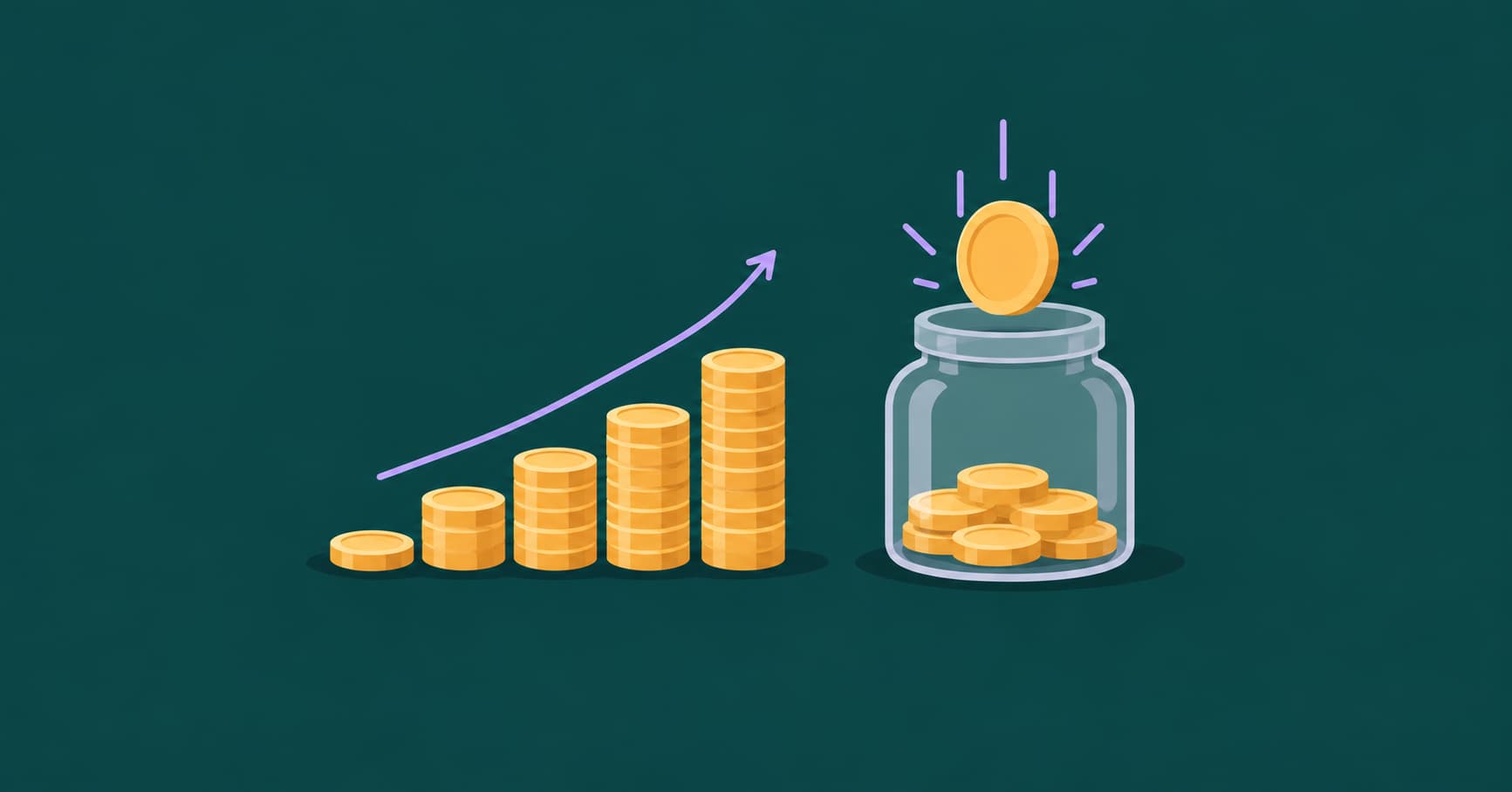
When you already have a large sum in hand, investing it all at once has historically come out ahead more often than spreading it out. Dollar-cost averaging, however, can feel safer, and feeling safe is what helps many people stay invested.
The two terms sound technical, but the question is simple: if you have a chunk of money to invest, do you put it in today, or in smaller pieces over time? In this article, we will look at what research says, what the difference looks like in dollars, and how to choose without second-guessing yourself.
The Two Approaches in Plain Words
Lump sum investing: you invest the whole amount right away.
Dollar-cost averaging (DCA): you split the amount into equal pieces and invest one piece at regular intervals, regardless of what the market is doing.
Imagine you receive $12,000 from a bonus or an inheritance. With a lump sum, all $12,000 goes into the market today. With DCA over six months, you would invest $2,000 now, $2,000 next month, and so on, until the last piece goes in. In the meantime, the money you have not yet invested sits in cash.
The appeal of DCA is that it spreads your entry across several prices, so you are never fully exposed to a bad day. The cost is that part of your money waits on the sidelines.
What the Research Says
Vanguard has studied this question across several markets. In its research summary, lump-sum investing outperformed a three-month cost-averaging plan between 61.6% and 73.7% of the time over rolling one-year periods, depending on the market, which Vanguard sums up as more than two-thirds of the time.
An earlier Vanguard study, described by Morningstar, found a similar result of about 66% for a 12-month DCA plan. It also found that longer plans lost more often: a 36-month plan trailed the lump sum about 90% of the time in U.S. markets.
The reason is straightforward. Markets have tended to rise more often than they fall, so money waiting in cash has usually missed some growth.
There are two important caveats. First, lump sum has a wider range of outcomes, which means the bad cases can be worse. Vanguard notes that cost averaging did better in the weakest outcomes. Second, these are historical results, and they say nothing certain about the future.
What It Looks Like in Dollars
Here is how the same $12,000 would fare under three simple, hypothetical markets over six months. The lump sum is invested on day one, and the DCA plan invests $2,000 at the start of each of six months.
Market over six months | Lump sum value | DCA value | Which came out ahead |
|---|---|---|---|
Steady rise (about 1.5% a month) | $13,121 | $12,646 | Lump sum, by $475 |
Steady fall (about 1.5% a month) | $10,960 | $11,386 | DCA, by $426 |
Dip, then recovery to the starting price | $12,000 | $12,605 | DCA, by $605 |
The figures assume no fees, and they count the value after the sixth month. The paths are invented to illustrate the mechanics, and they are not forecasts.
Notice the pattern. The lump sum wins when prices keep rising, because more of your money has been growing for longer. DCA wins when prices fall or dip, because later purchases happen at lower prices. Over history, rising markets have been more common, which is why lump sum has won more often. But the cases where DCA wins are exactly the ones that hurt.
The Regret Factor
The math is only half the story. Imagine investing $12,000 on Monday and watching the market fall 10% by Friday. That is a $1,200 paper loss in a week. Some people shrug it off. Others sell in a panic, and that does far more damage than any difference between the two methods.
If spreading out your purchases makes you far more likely to stay invested, then DCA may be the better plan for you in practice, even if it is slightly worse on average. A strategy you can stick with beats a better one you abandon.
The key is to keep the plan short and firm. Vanguard notes that if you do choose cost averaging, the opportunity cost is smaller when the money goes in over a short period, such as three months, rather than a year or more. Decide the schedule up front, and then follow it, whatever the market does.
If Your Money Arrives Monthly, You Are Already Doing DCA
Most people do not have a lump sum. They have a paycheck. Take Sarah, a 32-year-old renter with $4,000 in monthly take-home pay, who invests $400 a month straight from her paycheck. She is already practicing dollar-cost averaging, without having to decide anything.
For her, the question of lump sum versus DCA does not come up, because she cannot invest money she has not yet earned. The research mentioned above applies to money that is already in hand, and not to regular contributions from income. Her best move is the one she is already making: invest steadily, and keep going in good markets and bad.
How to Decide
A short guide:
Is the money for the long term? If you will not need it for many years, a lump sum has the stronger track record. If you may need it within a few years, the stock market may not be the right home for it at all.
Would a sharp drop make you sell? If the honest answer is yes, choose DCA over a short window. Staying invested matters more than squeezing out the last dollar.
Is it a one-time sum or regular income? Regular contributions are DCA by nature. Keep them automatic.
If you cannot decide, a compromise is perfectly reasonable. Invest half now and the other half over the next three months. You capture much of the benefit of getting started, and you soften the blow if the market dips right after.
Common Mistakes to Avoid
Stretching DCA over too long a period. The longer the money waits in cash, the more growth you may give up.
Waiting for a dip that never comes. Holding out for the perfect entry point often means missing months or years of growth.
Stopping your plan when the market falls. The point of DCA is to keep buying, including when prices are low.
Treating DCA as a way to avoid risk. It softens the entry, but your money is still exposed to the market once it is invested.
Using DCA on money you will need soon. Short-term money does not belong in the stock market, however you invest it.
The Short Version
Lump sum has historically beaten DCA more often than not, because markets tend to rise over time.
DCA does better when prices fall or dip, and it can make investing feel safer.
If your money comes from your paycheck, you are already doing DCA.
If you choose DCA for a lump sum, keep the plan short and automatic, such as three months.
A half now, half later split is a reasonable compromise.
The best method is the one that gets your money invested and keeps it there. Pick a plan you can follow without second-guessing it, and then let time do the work.
Disclaimer: This article is for educational purposes only and does not constitute financial, legal, or tax advice, and it is not a recommendation to buy or sell any security. The examples are hypothetical and simplified. Past performance does not guarantee future results, and all investing involves risk, including the possible loss of principal. Consider speaking with a qualified professional before making financial decisions.