For most beginners, a broad ETF is the simpler and sturdier core of a portfolio, and individual stocks can be a small add-on if you enjoy researching companies. The two are not enemies, and many investors hold both.
But the choice does matter, because it shapes how much time you spend, how much risk you take on, and how wide the range of possible outcomes becomes. In this article, we will compare the two with real numbers, so you can decide which fits your goals, your time, and your temperament.
What Each One Is
An individual stock is a small ownership stake in a single company. When you buy it, your result depends on how that one business performs.
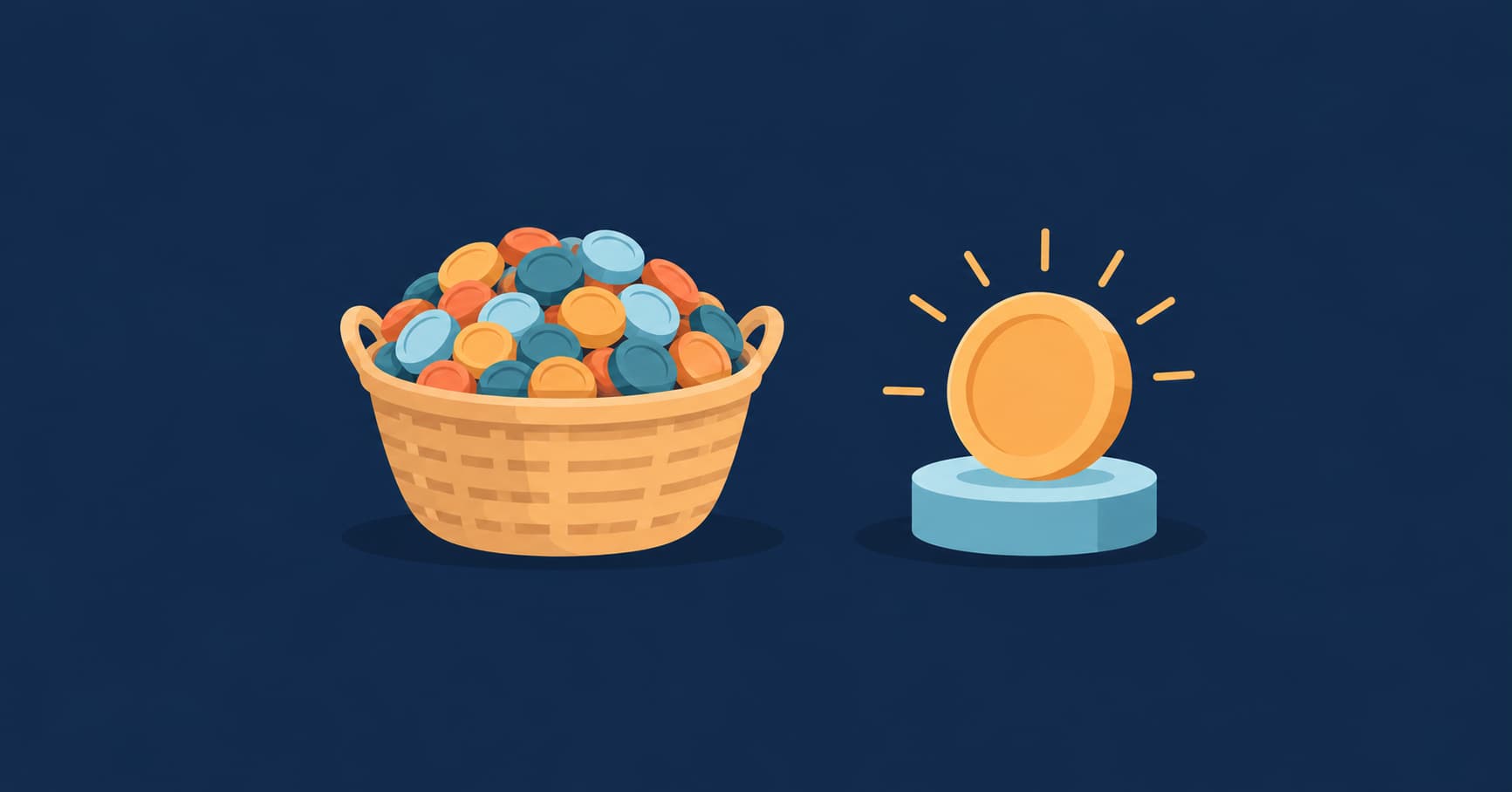
An ETF, short for exchange-traded fund, is a basket of investments that trades like a stock. A broad-market ETF might hold hundreds or thousands of companies, so a single purchase spreads your money across all of them.
The key difference is concentration. With a stock, you are betting on one company. With a broad ETF, you are owning a slice of the market.
Diversification in Dollars
Imagine you invest $10,000 and one company in your portfolio drops 50%.
If that company is your only holding, your $10,000 becomes $5,000, a loss of $5,000.
If it is one of 500 companies in an ETF, and we simplify by assuming each holds an equal share, your stake in it is $20. A 50% drop costs you $10, which is 0.1% of your portfolio.
Real funds weight larger companies more heavily, so the effect is not quite this tidy. Even so, the principle holds: when your money is spread widely, no single failure can do serious damage. When it is concentrated, one bad outcome can.
Side by Side
Broad index ETF | Individual stocks | |
|---|---|---|
Companies owned per purchase | Hundreds or thousands | One |
Time and research needed | Low | High |
Ongoing fund fee | A small annual fee, often 0.03% to 0.20% | None, but your time has a cost |
Range of outcomes | Close to the market's | Much wider, in both directions |
Control over what you own | Low | Full |
Damage if one company fails | Small | Can be severe |
Neither column is simply better. The ETF trades control for simplicity and safety, while stocks trade safety for control and the chance of a bigger win.
What the Evidence Says About Beating the Market
The appeal of individual stocks is the chance to do better than the market. It is possible, but the evidence suggests it is harder than it looks.
S&P Dow Jones Indices publishes a regular scorecard called SPIVA, which compares professional fund managers with their benchmarks. In its year-end 2024 report, 65% of actively managed large-cap U.S. stock funds trailed the S&P 500 that year, and over the 15 years ending December 2024, no fund category had a majority of managers beating its benchmark.
Another finding comes from finance professor Hendrik Bessembinder, whose research is summarized by Arizona State University's W. P. Carey School. He found that about 4% of U.S. stocks accounted for all of the wealth that stocks created above Treasury bill returns between 1926 and 2016.
Put simply, a small number of big winners drive most of the market's long-term gains. If you own the whole market through an ETF, you own those winners automatically. If you own a handful of stocks, you may miss them. These results describe the past, and they are not a promise about the future.
Which One Fits You?
Ask yourself a few honest questions:
A broad ETF may suit you if:
You want to invest without spending hours on research.
You would rather accept the market's return than risk falling well short of it.
You are likely to panic if a single holding drops sharply.
Individual stocks may suit you if:
You genuinely enjoy reading about companies and following their results.
You can afford losses on that portion of your money without losing sleep.
You are willing to hold through bad stretches, sometimes for years.
If you are unsure, start with the ETF. You can always add stocks later, but it is harder to undo a concentrated portfolio after a large loss.
A Middle Path: Core and Satellite
You do not have to choose one or the other. A popular approach is to hold a broad ETF as the core of your portfolio, and to keep a small satellite portion for individual stocks you want to follow.
Consider Sarah, a 32-year-old renter with $4,000 in monthly take-home pay, who invests $400 a month. She might put $360 (90%) into a broad ETF and $40 (10%) toward a few stocks she has researched. Over a year, that is $4,320 in the core and $480 in the satellite.
If her stock picks do well, she benefits. If they do badly, the damage is limited to a small slice of her portfolio, and her core keeps working. She gets to satisfy her curiosity without betting her future on it.
Common Mistakes to Avoid
Putting most of your money in one or two stocks. A strong story is not the same as a safe investment.
Buying what you already work for. If your paycheck and your portfolio depend on the same company, your risks stack up.
Assuming an ETF is automatically diversified. A fund focused on one narrow sector can be as concentrated as a handful of stocks. Check what it holds.
Chasing last year's winner. Strong past performance does not guarantee strong future results.
Trading too often. Frequent buying and selling adds costs and usually adds stress too.
The Short Version
A stock is a bet on one company, while a broad ETF is a slice of the whole market.
ETFs offer diversification and simplicity, and stocks offer control and a wider range of outcomes.
Beating the market is possible, but the evidence suggests it is difficult, even for professionals.
If you are unsure, start with a broad ETF as your core.
If you enjoy stock research, keep it to a small satellite portion.
There is no shame in choosing the simple option. For most people, the portfolio they can hold calmly for decades is the one that works.
Disclaimer: This article is for educational purposes only and does not constitute financial, legal, or tax advice, and it is not a recommendation to buy or sell any security. The examples are hypothetical and simplified. Past performance does not guarantee future results, and all investing involves risk, including the possible loss of principal. Consider speaking with a qualified professional before making financial decisions.