4 minutes of estimated reading time
The best place for an emergency fund is a separate, federally insured savings account that you can reach within a day or two. Not the stock market, not your everyday checking account, and not a place with penalties for taking your money out.
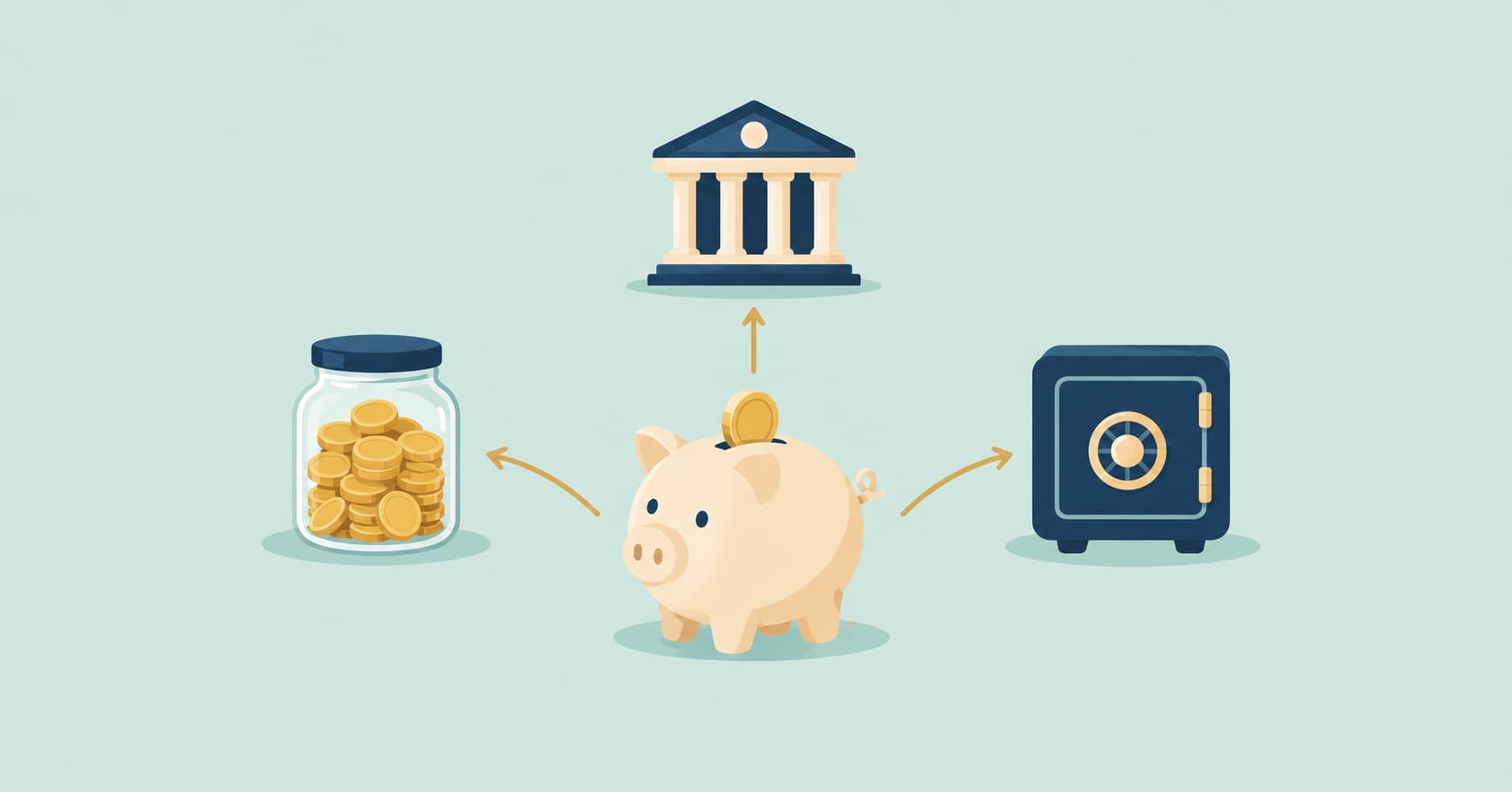
Once you know how much to save, the equally important question is where to put it. Choose well, and your cushion will be there, intact, on the day you need it. Choose poorly, and you might find it smaller, locked away, or already spent.
What Your Emergency Fund Needs From Its Home
Before comparing accounts, it helps to know what you are looking for. A good home for an emergency fund has three qualities:
Safe. The balance should not shrink because of market swings or a bank failure.
Accessible. You should be able to reach the money within a day or two, without penalties.
Separate. The money should sit apart from your everyday spending, so it does not quietly disappear.
Earning interest is a pleasant bonus, but it comes fourth. If an account is safe, accessible, and separate, you are most of the way there.
Why You Should Not Invest It
It is tempting. If $15,300 is sitting in savings, why not put it to work in the stock market? The problem is timing. Market drops and personal emergencies tend to show up together, because recessions bring layoffs.
Imagine that Sarah, a single renter, has built a $15,300 emergency fund, equal to six months of her essentials, and invested it in stocks. Then the market falls 20% in the same month she loses her job. Her fund is now worth about $12,240, a loss of $3,060. Her essentials cost $2,550 a month, so the cushion that was meant to cover six months now covers fewer than five. Worse, she would have to sell at a loss, at exactly the moment she cannot afford to wait.
That does not mean investing is a bad idea. It means investing and emergency savings have different jobs. Investing is for long-term goals, where you can wait out the dips. An emergency fund is for the short term, where you cannot.
Your Options, Compared
Option | Safety | Access | Fit for an emergency fund |
|---|---|---|---|
High-yield savings account | Insured up to $250,000 | Usually 1 to 2 business days by transfer | Best fit for most people |
Money market account (at a bank) | Insured up to $250,000 | Often quick; may offer checks or a debit card | Good alternative |
Traditional savings account | Insured up to $250,000 | Easy | Fine, but interest is often much lower |
Checking account | Insured up to $250,000 | Immediate | Too easy to spend; use only as a small buffer |
Certificate of deposit (CD) | Insured up to $250,000 | Early withdrawal penalty | Suitable only for a portion of a larger fund |
Treasury bills or money market funds | Treasury bills are backed by the U.S. government; money market funds are not FDIC insured | Usually a few business days to sell and settle | Possible for a portion, but adds complexity |
Stocks, ETFs, or crypto | Not insured; value can fall | Can be sold any day, at an uncertain price | Not suitable |
Two details are worth knowing. First, FDIC insurance covers bank deposit accounts, not investments. The standard limit is $250,000 per depositor, per insured bank, per ownership category, and credit unions offer equivalent coverage through the NCUA. Second, "money market account" and "money market fund" sound alike but are different products. The first is a bank deposit account and is insured. The second is an investment product and is not.
A Simple Setup That Works for Most People
You do not need anything complicated. Here is a setup that works well for most people:
Open a separate high-yield savings account. Many people choose a different bank from their main checking account, so the money is not one tap away.
Give it a clear name, such as "Emergency Fund," so you remember what it is for.
Automate your contributions on payday, even if the amount is small at first.
Skip the debit card. If the account has one, you do not need to link it to your daily spending.
If your fund is large, you can go one step further. Sarah's $15,300 fund, for example, could be split: $10,200 in a high-yield savings account (four months of essentials, available quickly) and $5,100 in a short-term CD or Treasury bills. This is optional, and the savings account alone is perfectly fine. Just never lock away so much that you could not cover the first few weeks of an emergency.
What to Look for in an Account
When you compare accounts, check these points:
Deposit insurance. The bank should be FDIC insured, or the credit union NCUA insured.
No monthly fees and no minimum balance you might struggle to meet.
Easy transfers to your checking account, ideally within one business day.
A competitive interest rate. Rates change often, so compare them from time to time. But do not chase every small difference. Safety and access matter more than a slightly higher rate.
Also keep in mind the insurance limit. At $250,000 per depositor, per insured bank, per ownership category, most emergency funds sit comfortably within it.
Common Mistakes to Avoid
Putting the whole fund in CDs. The penalty for early withdrawal can eat into your money exactly when you need it.
Mixing up a money market account and a money market fund. Only the first is a bank deposit with FDIC insurance.
Leaving the money in checking. When the balance looks large next to your daily spending, it becomes easy to dip into.
Switching accounts constantly for a higher rate. The extra interest is small, and the hassle and risk of errors add up.
Never checking whether the account is insured. It takes a minute, and the FDIC offers a free tool, the Electronic Deposit Insurance Estimator, to help.
The Short Version
Your emergency fund should be safe, accessible, and separate.
A high-yield savings account at an insured bank or credit union fits most people best.
Do not invest it. Markets can fall exactly when you need the money.
Use CDs or Treasury bills, if at all, for only a portion of a larger fund.
Where you keep the money matters less than making sure it is there when you need it. Pick a simple, insured account, automate your deposits, and let it quietly do its job.
Disclaimer: This article is for educational purposes only and does not constitute financial, legal, or tax advice. Account features, interest rates, and insurance rules can change, so confirm current details with the institution and consider speaking with a qualified professional before making financial decisions.