4 minutes of estimated reading time
Many people keep their savings in a regular checking account because it is convenient. The trouble is that checking accounts often pay very little interest, so cash sits there while prices rise around it.
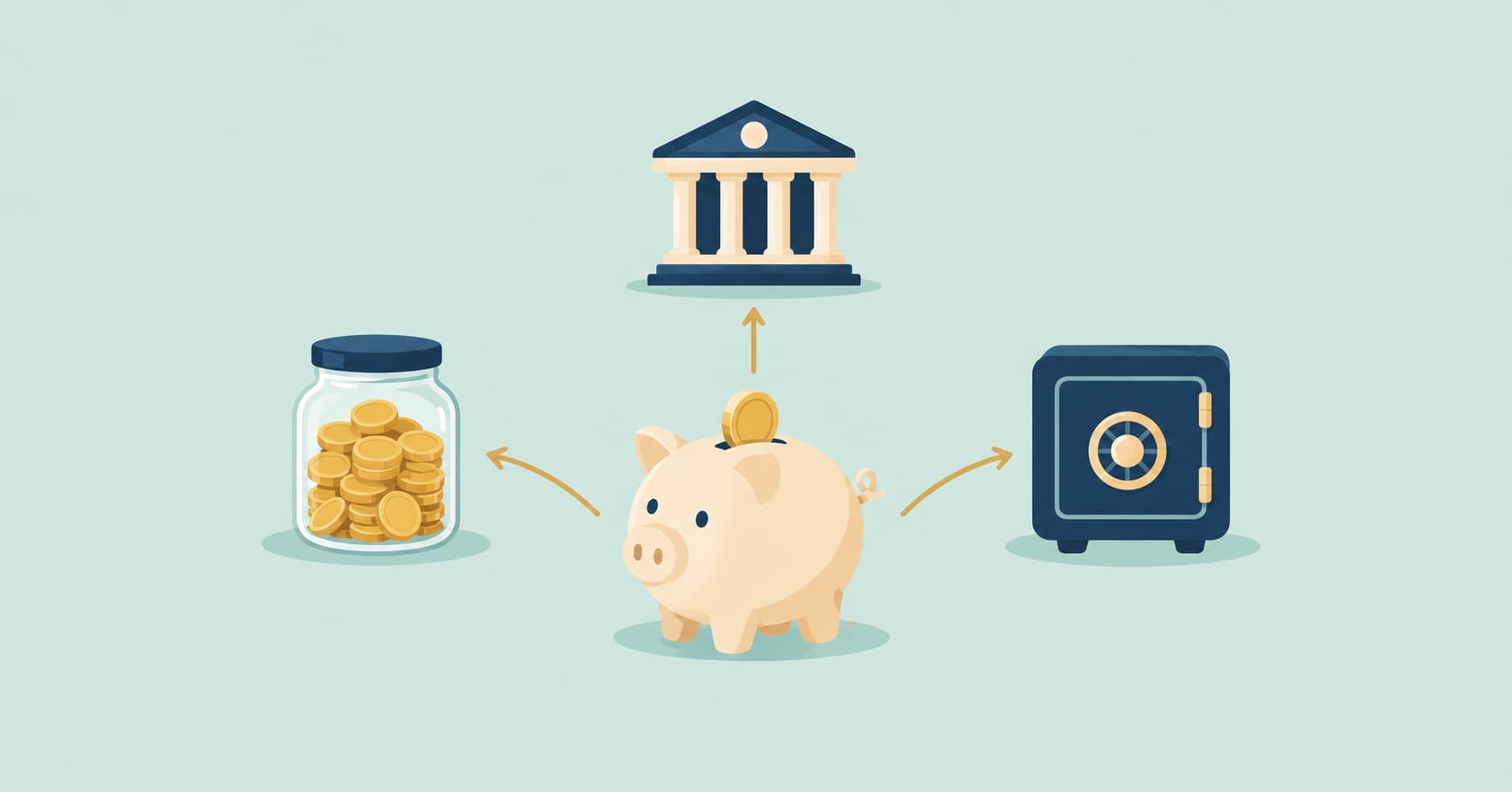
If you have money you want to keep safe and easy to reach, there are better places to put it. Three of the most common options are high-yield savings accounts, certificates of deposit (CDs) and Treasury bills. They look similar, but they work differently. This guide explains each one, compares them side by side, and shows how to match the right tool to the job.
High-Yield Savings Accounts
A high-yield savings account is a bank account that pays a higher interest rate than a standard savings or checking account. Online banks often offer the best rates, because they have lower costs than banks with many branches.
The key features:
Variable rate. The bank can raise or lower your rate at any time, usually following broader interest rates.
Easy access. You can generally move money in and out without penalty, although some accounts limit the number of monthly transfers.
Deposit insurance. At an FDIC-insured bank, deposits are covered up to $250,000 per depositor, per bank, per ownership category (FDIC).
The trade-off is that the rate can fall when the economy changes. What you gain is flexibility.
Certificates of Deposit (CDs)
A CD is a savings product where you agree to leave your money with the bank for a set period, such as six months, one year or five years. In return, the bank typically pays a fixed interest rate for that whole period.
The key features:
Fixed rate and fixed term. You know what you will earn if you hold the CD until it matures.
Early withdrawal penalty. If you take the money out before the end of the term, you generally pay a penalty (CFPB). Penalties vary, so compare them.
Deposit insurance. Bank CDs are insured up to $250,000 by the FDIC, and credit union CDs by the NCUA.
A CD can make sense when you know exactly when you will need the money and want to lock in a rate. If rates fall later, you keep your higher rate. If rates rise, you are stuck with the lower one until the CD matures.
Treasury Bills (T-Bills)
A Treasury bill is a short-term loan to the U.S. government. You buy it at a discount to its face value, and at maturity you receive the full face value. The difference is your interest. For example, a $1,000 bill bought for $982.73 pays $17.27 at maturity (NerdWallet).
The key features:
Short terms. Bills mature in four weeks to one year, with common terms of 4, 8, 13, 17, 26 and 52 weeks.
Government backing. They are backed by the U.S. government and considered virtually risk-free if held to maturity.
Tax treatment. Interest is subject to federal income tax but exempt from state and local income tax. For people in high-tax states, that can matter.
Where to buy. Through TreasuryDirect.gov or through a brokerage account.
Unlike a bank account, a T-bill is not covered by FDIC insurance, because the protection comes from the government's backing instead. You can usually sell one before maturity through a broker, but the price you get may differ from what you paid.
Side by Side
High-yield savings | CD | Treasury bill | |
|---|---|---|---|
Interest rate | Variable | Fixed for the term | Fixed at purchase (discount) |
Access to your money | Flexible | Penalty for early withdrawal | Held to maturity, or sold at market price |
Safety | FDIC-insured up to $250,000 | FDIC or NCUA-insured up to $250,000 | Backed by the U.S. government |
Taxes | Interest taxed at federal, state and local level | Interest taxed at federal, state and local level | Federal tax only; exempt from state and local |
Typical terms | None | Months to years | 4 to 52 weeks |
Often suits | Emergency funds and flexible savings | Money with a known date, rate locked in | Short-term goals, especially in high-tax states |
None of these will make you rich. Their job is to keep money safe, accessible when needed and earning something while it waits. Rates change constantly, so check current offers before deciding.
Example: Sarah and Her Emergency Fund
Sarah is 32, rents her apartment and takes home about $4,000 a month. She has built an emergency fund of $15,000 and keeps it in her checking account, which pays almost nothing.
Suppose her checking account pays 0.01% and a high-yield savings account pays a hypothetical 4%. Over a year, $15,000 would earn about $1.50 in checking and about $600 in the high-yield account. Same money, same safety, very different result.
For an emergency fund, flexibility is the priority. Sarah may need the money tomorrow if her car breaks down or her job changes. A CD with a penalty or a T-bill that needs to be sold would add friction at the worst possible moment. A high-yield savings account fits this job well.
Rates in this example are hypothetical and will differ when you read this.
Example: Daniel and a Known Date
Daniel is a 38-year-old freelancer with variable income. He has set aside $6,000 for a quarterly estimated tax payment due in about six months. He knows the date and the amount, and he does not want to touch the money before then.
This is a different situation. Because the date is fixed, Daniel does not need flexibility, and he can lock in a rate. A six-month CD or a 26-week T-bill matches his timeline. At a hypothetical 4% annual rate, $6,000 would earn roughly $120 over six months.
If Daniel lives in a state with income tax, the T-bill's exemption from state and local tax could make it more attractive than a CD with a similar rate. If he would rather keep things simple at his bank, a CD works too. The point is that the choice follows the purpose of the money.
The figures here are hypothetical and ignore taxes and fees.
How to Choose
Start with the purpose of the money, not the rate. These questions help:
When will I need this money? If you might need it at any moment, favor flexibility. If you know the date, a fixed-term product can fit.
Can I tolerate a penalty or a market price? If not, choose a savings account.
Do I care about rate changes? A variable rate can fall; a fixed rate protects you until maturity but can lag if rates rise.
What are my taxes? If you pay state income tax, a T-bill's exemption may be worth comparing.
Am I within the insurance limits? Keep balances in one bank and one ownership category within $250,000, or spread them across institutions.
Many people use more than one: a high-yield savings account for emergencies and a CD or T-bill for a specific upcoming expense.
Common Mistakes to Avoid
Chasing the highest advertised rate. Introductory or promotional rates can drop. Check how long a rate lasts and what conditions apply.
Locking up emergency money. A penalty for early withdrawal defeats the purpose of an emergency fund.
Ignoring inflation. A safe rate can still earn less than rising prices, so these products protect your money's availability more than its long-term purchasing power.
Exceeding insurance limits. Large balances above $250,000 in the same category at the same bank are not fully covered.
Using these for long-term goals. Money you will not need for many years may be better suited to investments, with the added risk that comes with them.
Letting a CD roll over without checking. Many renew automatically at whatever rate is offered at the time.
The Short Version
A high-yield savings account offers a variable rate and easy access, with FDIC insurance up to $250,000.
A CD offers a fixed rate for a fixed term, with a penalty for early withdrawal.
A Treasury bill is a short-term loan to the U.S. government, taxed federally but not at state or local level.
Match the product to the purpose and timing of the money, not just the rate.
Rates change often, so compare current offers.
Disclaimer
This article is for educational and informational purposes only and does not constitute financial, investment, tax or legal advice. Interest rates, insurance limits and tax rules change, and the information reflects the sources cited at the time of writing. Treasury securities and bank products have different features and risks; read the terms of any product before you buy. Past performance does not guarantee future results. Examples, including the people and figures used, are hypothetical and are provided for illustration only. Consider your personal situation and consult a qualified professional before making financial decisions.