You can start investing with as little as $100 a month, and in the beginning, the habit matters more than the amount. A small, automatic contribution into a simple, low-cost fund is a solid first step.
Many people put off investing because they believe they need thousands of dollars, a finance degree, or the ability to spot the next big stock. None of that is true. In this article, we will walk through four simple steps, with real numbers, so you can start with whatever you can spare.
Why a Small Start Is Fine
It used to be hard to invest small amounts, but that has changed. Many brokerages now have no account minimums, and many let you buy fractional shares, which means you can invest a set dollar amount instead of needing enough for a whole share.
Consider Elena, a 24-year-old in her first full-time job, with $2,800 in monthly take-home pay. She can comfortably spare $100 a month, about 4% of her take-home pay. That may not sound like much, but it gives her something more valuable than the money itself: a habit that she can grow as her income does.
Before You Invest: Three Quick Checks
A few minutes of preparation makes investing much less stressful:
Have a small cushion. Aim for around $1,000 in savings, so that a surprise bill does not force you to sell your investments at a bad moment.
Look at your debts. If you carry credit card debt at 20% or more, paying it down usually beats investing. The interest you avoid is guaranteed, while investment returns are not.
Check for an employer match. If your employer adds money when you contribute to a retirement plan, capture it first. It is one of the best deals available.
Step 1: Choose an Account
The account is the container that holds your investments. In the United States, there are three common choices:
An employer plan, such as a 401(k). Contributions come straight from your paycheck, and many employers add a match.
An IRA (traditional or Roth). You open it yourself at a brokerage. Annual contribution limits and eligibility rules apply, so check the current IRS figures.
A regular taxable brokerage account. It is the most flexible, with no contribution limits, but it has no special tax treatment.
For many beginners, a sensible path is to contribute enough to earn any employer match, and then to use an IRA or a taxable account for additional savings.
Step 2: Choose a Simple, Low-Cost Fund
You do not need to pick individual stocks. Two simple options cover most beginners:
A broad index fund or ETF. It holds hundreds or thousands of companies in a single purchase, so you are not relying on any one of them.
A target-date fund. It chooses a mix of investments based on the year you expect to retire, and gradually becomes more conservative as that year approaches.
Picking individual stocks can come later, if you ever want to. It is not a requirement for getting started.
Step 3: Automate It
Set up a recurring transfer and a recurring purchase, scheduled for the day after you get paid. Investing a fixed amount on a regular schedule removes the temptation to wait for the "right" moment, and it takes willpower out of the equation.
Step 4: Keep Costs Low
Every fund charges an annual fee, called an expense ratio. Broad index funds often charge somewhere between 0.03% and 0.20% a year, while actively managed funds frequently charge 0.5% to 1% or more. That difference looks tiny, but it compounds.
Suppose Elena invests $100 a month for 30 years and earns a hypothetical 7% a year before fees. With a 0.05% fee, she ends up with about $120,800. With a 1.00% fee, she ends up with about $100,500. That is a gap of roughly $20,300, on just $36,000 of contributions.
What $100 a Month Can Grow Into
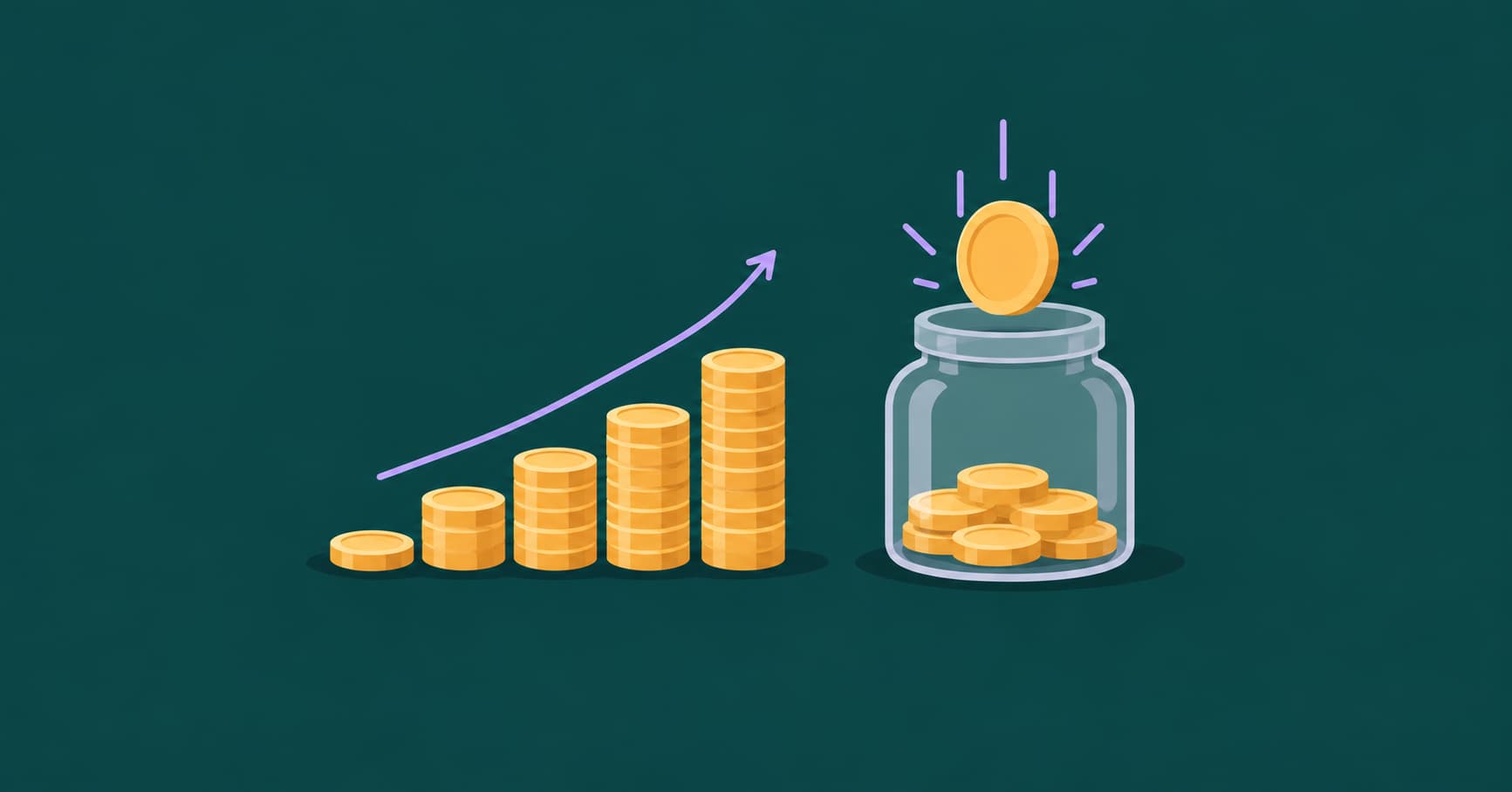
Here is what $100 a month could become at a hypothetical 7% annual return. These figures are illustrations, not predictions.
Years of investing | Total you contributed | Hypothetical value |
|---|---|---|
10 | $12,000 | $17,300 |
20 | $24,000 | $52,100 |
30 | $36,000 | $122,000 |
The figures assume monthly contributions and monthly compounding, and they ignore taxes, fees, and inflation. Real returns vary from year to year and can be negative, sometimes for several years in a row.
Notice how the growth speeds up. In the first ten years, most of the balance is your own money. By year 30, most of it is growth. Time does a great deal of the work, which is why starting early matters more than starting big.
How to Raise the Amount Over Time
The easiest way to invest more is to increase your contribution in small steps, so you barely feel it. Two ideas work well:
Add a little each year. Suppose Elena raises her contribution by $25 every year, from $100 to $125, then $150, and so on, reaching $325 a month in year ten. At a hypothetical 7%, she would have about $34,300 after ten years, compared with about $17,300 if she had stayed at $100.
Send part of every raise to investing. When your pay goes up, direct half of the increase to your account, and enjoy the rest.
If you receive a tax refund or a bonus, consider investing a portion of it too.
Common Mistakes to Avoid
Waiting until you have "enough". Delay costs you time, and time is the one ingredient you cannot buy back.
Trying to time the market. Nobody can reliably predict the best day to buy. A steady schedule is simpler and often calmer.
Chasing hot stocks or trends. Money you cannot afford to lose does not belong in speculative bets.
Checking your balance every day. Short-term dips are normal, and watching them closely can tempt you to sell at the wrong time.
Ignoring fees. A small percentage adds up over decades.
Investing money you will need soon. If you need it within a few years, a savings account is the safer home.
The Short Version
You can start with $100 a month, or even less.
First, have a small cushion, check your debts, and capture any employer match.
Choose an account, then a simple, low-cost fund, such as a broad index fund or a target-date fund.
Automate your contributions, and keep an eye on fees.
Raise the amount a little each year, and give your money time to grow.
The best time to start is the moment you can spare a small amount consistently. The first $100 matters less for its size than for the habit it starts.
Disclaimer: This article is for educational purposes only and does not constitute financial, legal, or tax advice. The examples are hypothetical and simplified, and the returns shown are not guaranteed or a prediction of future results. All investing involves risk, including the possible loss of principal. Account rules, limits, and fees change, so confirm current details and consider speaking with a qualified professional before making financial decisions.