4 minutes of estimated reading time
You build a careful monthly budget. Rent, groceries, utilities, a little for savings. Then March arrives with a car insurance bill, or December brings gifts and travel, and the whole plan wobbles.
The problem is rarely a lack of discipline. It is that many expenses are not monthly. They show up once or twice a year, they are predictable, and they are easy to forget until the bill arrives. A simple tool called a sinking fund solves this. This guide explains how it works and how to set one up in under an hour.
What a Sinking Fund Is
A sinking fund is money you set aside gradually for a specific expense that you know is coming. Instead of paying a $1,200 insurance bill in one painful month, you put aside $100 every month for twelve months. When the bill arrives, the money is already there.
It differs from an emergency fund in one key way: an emergency fund is for the unexpected, while a sinking fund is for the expected. You may not know exactly when your car will need repairs, but you know that cars need maintenance. You know the holidays arrive every year. These costs are irregular, not surprising.
Keeping the two separate has a practical benefit. If you use your emergency fund for predictable expenses, it will be empty when a real emergency shows up.
Common Sinking Fund Categories
Anything predictable but not monthly is a candidate. Common examples include:
Insurance premiums paid every six or twelve months
Car maintenance and repairs, including tires and registration
Gifts and holidays, including birthdays and celebrations
Travel and vacations
Annual subscriptions and memberships
Medical and dental costs, such as deductibles and glasses
Home or apartment items, such as replacing a mattress or appliances
Taxes for people who pay estimated taxes or owe a balance
Large planned purchases, such as a laptop or a phone
You do not need all of them. Start with the two or three that cause the most stress.
How to Set Up a Sinking Fund in Five Steps
List your irregular expenses. Look back through the past twelve months of bank and card statements and note every bill or purchase that was not monthly.
Estimate the annual cost. Use last year's amounts, and round up slightly if prices have risen.
Divide by twelve. The result is how much to set aside each month for that category.
Automate the transfers. Set up a recurring transfer on payday so the money moves before you can spend it.
Keep each fund visible. Track how much belongs to each category, either with separate sub-accounts or a simple spreadsheet.
When the bill arrives, you pay it from the fund. Then the fund starts building again for next year.
Example: Sarah's Four Funds
Sarah is 32, rents her apartment and takes home about $4,000 a month. After reviewing her statements, she finds four irregular expenses that keep disrupting her budget:
Sinking fund | Annual cost | Monthly amount |
|---|---|---|
Car insurance | $1,200 | $100 |
Holiday gifts | $600 | $50 |
Vacation | $1,800 | $150 |
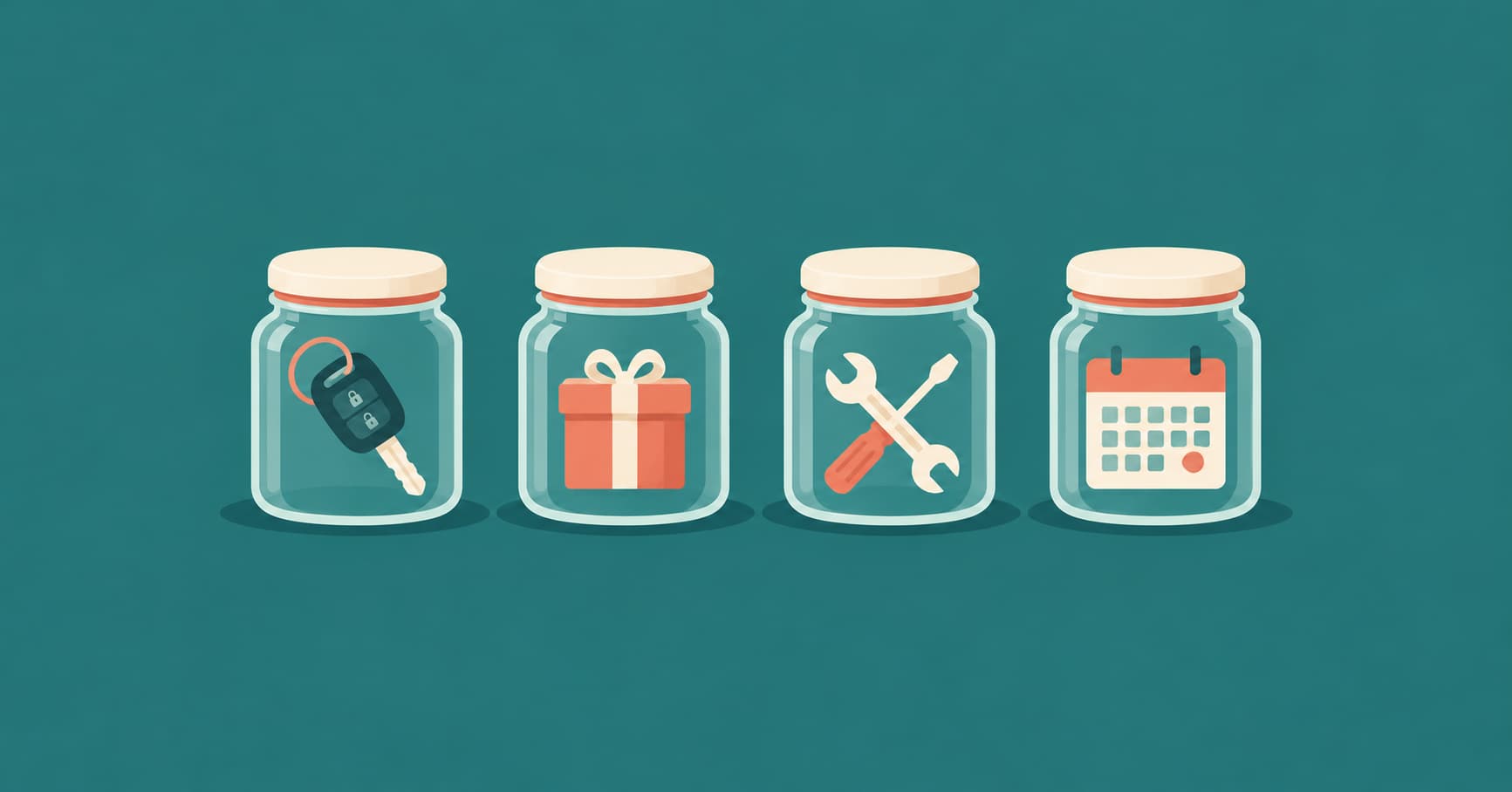
Car maintenance | $600 | $50 |
Total | $4,200 | $350 |
The total is $350 a month, which is about 9% of her take-home pay. That may feel like a lot, but it is not new spending. These costs were already coming. The difference is that Sarah now meets them with money she has already set aside, instead of using a credit card or pulling from her emergency fund.
The amounts are hypothetical and will differ for everyone.
Example: Daniel and Irregular Income
Daniel is a 38-year-old freelancer, and his income changes from month to month. A fixed monthly transfer can be hard to keep in a slow month.
He lists three irregular expenses: annual software at $480, equipment replacement at $1,500 and a health insurance deductible at $1,800. Together they come to $3,780 a year, or $315 a month on average.
Instead of a fixed amount, Daniel funds his sinking funds as a percentage. Each time a client pays him, he transfers 6% of the payment into his sinking funds, and he adds extra in strong months. In a slow month the contribution is smaller, but it keeps going. By the end of the year, the total is what matters, and he can check it against his $3,780 target.
This approach works well for anyone whose income varies. The habit is to move money first, based on what came in, instead of waiting to see what is left.
Where to Keep the Money
Sinking funds are short-term money, so safety and access matter more than growth. A savings account is usually the best fit. Many banks let you create several sub-accounts or "buckets" inside one account and give each a name, such as "Car insurance" or "Vacation." If yours does not, a single account with a simple spreadsheet tracking each category also works.
A few practical tips:
Use a separate account from your checking account. Money that is out of sight is less likely to be spent by accident.
Choose an account that pays interest. A high-yield savings account can earn a little while the money waits.
Keep it accessible. You may need the money on a specific date, so avoid anything with penalties or delays.
Do not invest it. Money you will need within a year should not be exposed to market swings.
Common Mistakes and How to Adjust
Skipping the review of past statements. Guessing leads to missed expenses. Twelve months of data is a better guide than memory.
Using the emergency fund instead. If a predictable bill drains your emergency fund, you do not have a sinking fund yet. Rebuild the emergency fund and start the sinking fund separately.
Starting with too many categories. Three or four funds are easier to maintain than fifteen.
Setting amounts once and never revisiting them. Prices change. Review your list once or twice a year.
Raiding the funds for something else. If you borrow from one fund, decide how and when you will repay it.
Giving up after a miss. If a bill is larger than expected or a month goes badly, adjust the monthly amount and continue. A partly funded plan still reduces the shock.
If you cannot afford all your sinking funds at once, begin with the one or two that are due soonest.
The Short Version
A sinking fund is money set aside gradually for a predictable, irregular expense.
It is different from an emergency fund, which is for the unexpected.
Divide the annual cost by twelve and automate the transfer.
Keep the money in a separate, accessible savings account.
If your income varies, fund the plan with a percentage of what comes in.
Disclaimer
This article is for educational and informational purposes only and does not constitute financial, investment, tax or legal advice. Individual circumstances differ, and the strategies described may not suit everyone. Examples, including the people and figures used, are hypothetical and are provided for illustration only. Consider your personal situation and consult a qualified professional before making financial decisions.