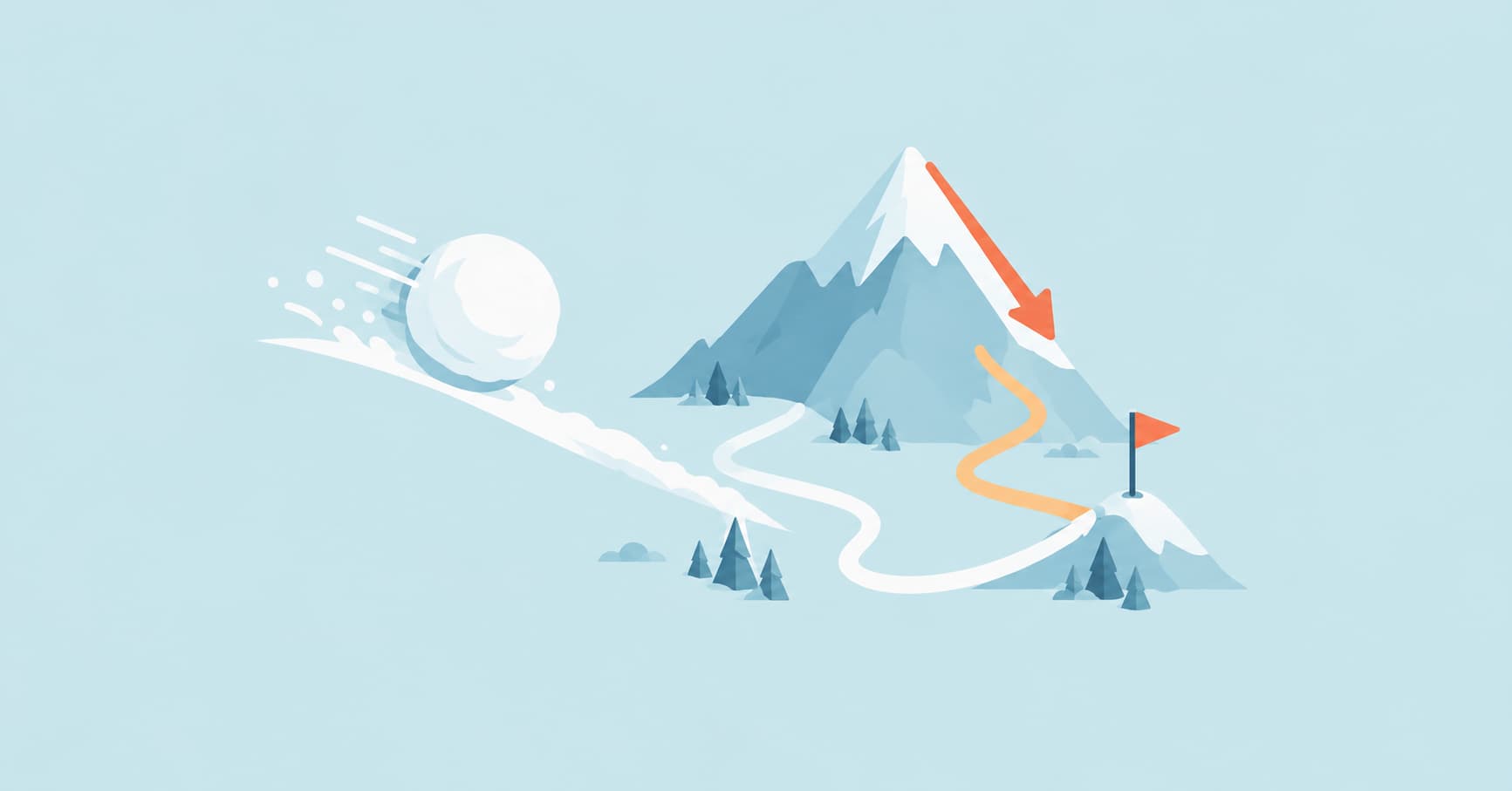
Both the debt snowball and the debt avalanche work. The avalanche usually costs a little less in interest, and the snowball gives you quicker wins, so the better choice is the one you will actually stick with.
If you are paying off more than one debt, you have probably heard both names. Online, the debate can get heated, but the real question is simpler: what will keep you going until the last balance reaches zero? In this article, we will compare the two methods using the same set of debts, so you can see the trade-off in actual dollars.
The Two Methods in One Minute
Both methods start the same way. You pay the minimum on every debt, so nothing goes into default, and you choose one debt to receive every extra dollar. They differ only in which debt that is:
Debt snowball: list your debts from the smallest balance to the largest, and attack the smallest first.
Debt avalanche: list your debts from the highest interest rate to the lowest, and attack the highest rate first.
When a debt is paid off, you take the full amount you were paying on it, minimum included, and add it to the next target. That growing payment is what gives each method its name.
A Worked Example
Consider Marcus, a 35-year-old with a steady job and three debts:
Debt | Balance | Interest rate (APR) | Minimum payment |
|---|---|---|---|
Personal loan | $1,500 | 9% | $50 |
Credit card | $4,000 | 22% | $100 |
Car loan | $9,000 | 6% | $200 |
Total | $14,500 | $350 |
Marcus can put $600 a month toward debt: the $350 in minimums plus $250 extra. We will run the same numbers through both methods.
Marcus With the Snowball
The snowball targets the smallest balance first, so the extra $250 goes to the $1,500 personal loan. It is gone in month 6, which is an early and visible win. Marcus then rolls that payment into the credit card, which is cleared in month 16, and finally into the car loan, which is cleared in month 27.
Total interest paid along the way is about $1,647.
Marcus With the Avalanche
The avalanche targets the highest rate first, so the extra $250 goes to the 22% credit card. It is cleared in month 13, and the freed-up payment moves to the personal loan, which is cleared in month 16. The car loan, with its low 6% rate, comes last and is cleared in month 27.
Total interest paid is about $1,472.
Side by Side
Snowball | Avalanche | |
|---|---|---|
First debt cleared | Month 6 | Month 13 |
Debt-free | Month 27 | Month 27 |
Total interest paid | $1,647 | $1,472 |
In this example, the avalanche saves about $175 over 27 months, or roughly $6.50 a month. The snowball gives Marcus his first win seven months sooner.
Two things stand out. First, the gap between the methods is real but modest. It grows when a large balance carries a very high rate, and it shrinks when your rates are similar. Second, the bigger lever is the extra payment itself. If Marcus paid only the $350 in minimums, with the payments staying fixed, he would be in debt for about 54 months and pay roughly $4,200 in interest. The extra $250 cuts that to 27 months and saves more than $2,500, whichever method he picks.
These figures are simplified. They assume fixed payments, monthly interest, and no new borrowing.
Which One Fits You?
A useful way to decide is to ask what has gotten in your way before.
The snowball may suit you if:
You have tried to pay off debt before and lost steam.
You have several small balances that could disappear quickly.
You are motivated by seeing accounts close and the list getting shorter.
The avalanche may suit you if:
You are motivated by numbers and efficiency.
One or two high-rate balances are doing most of the damage.
You can stay patient even when the first win is a few months away.
If your highest-rate debt also happens to be your smallest, you do not need to choose. Both methods point to the same target.
A Hybrid and a Few Rules for Both
You are allowed to mix the methods. One popular approach is to clear a very small debt first for a quick win, then switch to the avalanche for everything else. You get the early momentum and most of the interest savings.
Whichever path you choose, these habits matter more than the method:
Never skip a minimum. Late fees and penalty rates can erase your progress.
Automate the payments, including the extra amount, so that it leaves your account on payday.
Roll every freed-up payment forward. The method only works if the money keeps moving to the next debt.
Keep a small cushion, such as $1,000, so that a surprise bill does not go straight back onto a credit card.
Ask your lenders about a lower rate. It does not always work, but a call costs nothing.
Common Mistakes to Avoid
Spending the freed-up payment. When a debt disappears, the temptation is to treat that money as a raise. Redirect it instead.
Switching methods every month. Pick one for at least six months before judging it.
Adding new debt while paying down old debt. Otherwise, you are running to stand still.
Ignoring your interest rates. Even if you choose the snowball, know your rates, so that you understand what each month costs you.
Waiting for a perfect plan. A good plan started this month beats a perfect one started next year.
The Short Version
The snowball pays the smallest balance first. It delivers quicker wins.
The avalanche pays the highest rate first. It usually costs less in interest.
In our example, both finished in 27 months, and the avalanche saved about $175.
The extra payment matters more than the method.
Choose the approach you will stick with, and keep every freed-up payment moving forward.
There is no shame in choosing the method that keeps you motivated. Finishing a slightly more expensive plan beats abandoning a cheaper one halfway through.
Disclaimer: This article is for educational purposes only and does not constitute financial, legal, or tax advice. The example is hypothetical and simplified, and real interest rates, fees, and loan terms vary. Consider speaking with a qualified professional, such as a nonprofit credit counselor, before making financial decisions.